20 November 2026
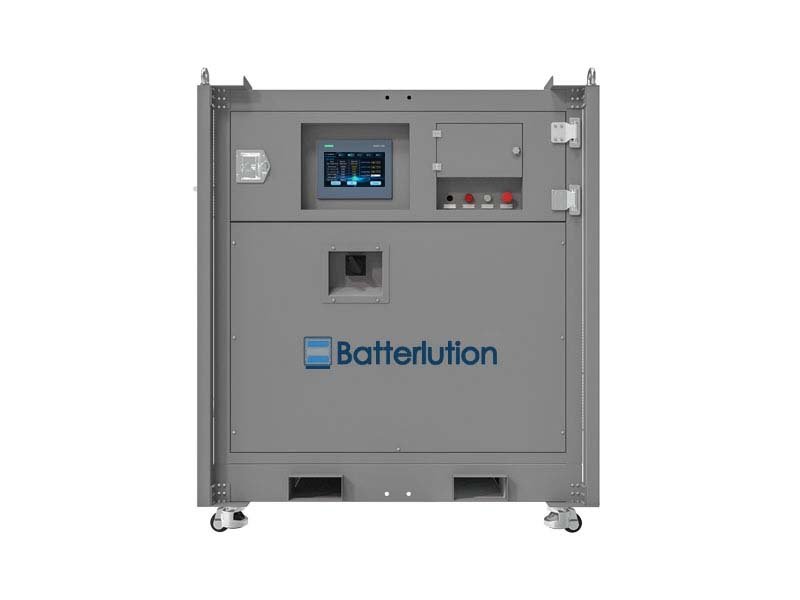
Liquid Cooled Load Bank
Main Parameters
|
Rated Parameters of The Power Supply Under Test |
AC400V/50~60Hz/3P5W+ AC400V/50~60Hz/3P5W |
|---|---|
|
Rated Power of The Load |
Resistive Load |
|
Load Characteristics |
Delta Connection |
|
Loading Accuracy |
±3% |
|
Three-Phase Balance |
≤3% |
|
Load Regulation Capability |
Adjustable 0-60kW, minimum step 1kW |
|
Load Power Factor |
1.0 |
|
Load Protection Function |
Voltage/current protection, overload protection, phase loss protection, current imbalance protection, temperature protection, communication interruption protection, liquid leakage protection, etc. |
|
Water Circuit Working Mode |
Manual flow adjustment / automatic flow / automatic temperature difference / automatic pressure difference |
|
Load Control |
Contactor Execution |
|
Load Working Mode |
Continuous Operation |
|
Cooling Method |
Liquid Cooling |
|
Operation Mode |
Touchscreen local control; remote control via upper computer |
|
Measurement and Control Function |
Touchscreen control, measuring the voltage, current, power, frequency, etc. of the power supply under test |
|
Load Expansion |
Parallel expansion of 1+N load units |
|
Operating Environment |
Indoor Type |
|
Operating Ambient Temperature |
Range: -10°C to +55°C |
|
External Dimensions |
450×355×1050mm (W×H×D, cabinet); reference dimensions, customizable |
|
Ref. weight |
84kg |
|
Box Color |
Gray wrinkle finish / customizable |
|
Operating Altitude |
≤2000m |
|
Installation and Transportation |
Cabinet with load-bearing lifting holes and casters |
|
Insulation Class |
F |
|
Product Application Scope |
Suitable for data center power supply testing and cooling system testing |
Features
-
This liquid-cooled load bank supports automatic flow regulation, offering modes such as automatic flow control, automatic temperature-difference control, and automatic pressure-difference control—making it highly suitable for performance evaluation of liquid-cooling systems.
-
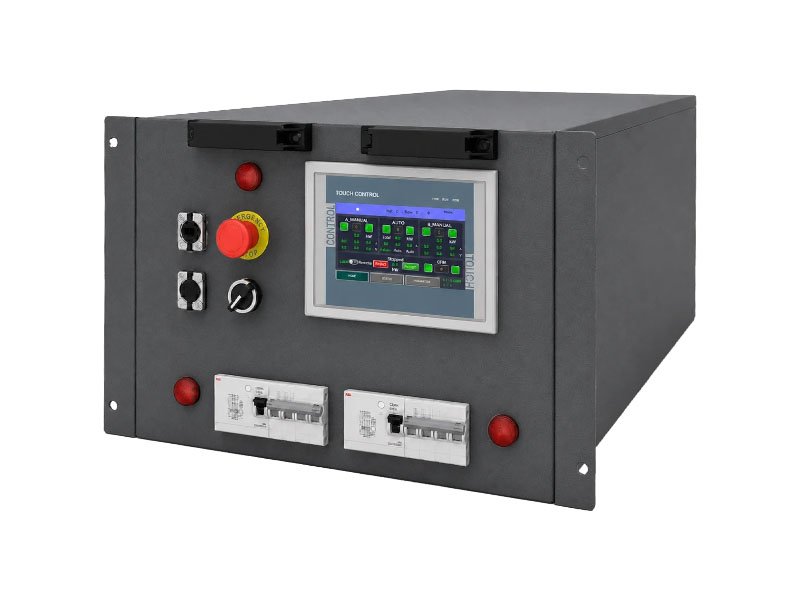
It supports both local and remote control. Local operation is managed via an onboard touchscreen, ideal for single-unit testing or "plug-and-play" deployment scenarios. Remote control is designed for multi-unit testing, allowing for coordinated operation across several liquid-cooled load banks, including different models.
-
Network setup is straightforward: units can be cascaded via wired connections, or a wireless network can be established using a router within the test area. This enables rapid network configuration for multi-device, coordinated testing.
-
Paired with dedicated control software, the system facilitates centralized monitoring and coordinated control of the load banks, as well as the recording and analysis of test data—such as inlet/outlet coolant temperatures, hydraulic pressure, flow rate, cabinet temperature, and actual load power.
-
The unit supports load-step testing (sudden application or removal of load) across a power range of 0 to 60 kW; higher power capacities can also be customized.
-
It features automatic dual-power-source switching: if only one power source is active, the full load is applied to that circuit; when both sources are available, the load is automatically distributed equally (50%–50%) between them.
-
The system provides real-time display and recording of electrical parameters, including current, voltage, frequency, and power.
-
Test data can be exported as CSV files, and the software can automatically generate test reports. Users can also monitor the real-time operational status of the load bank in greater detail via a PC.
-
To ensure long-term operational reliability, the load bank is equipped with comprehensive protection features, including safeguards against overvoltage/overcurrent, overload, phase loss, current imbalance, excessive temperature, communication failure, and coolant leakage.
Rack Mounted Liquid cooled Load Bank Customization Services
Rated Power & Loading Step Customization
Adjust the single-unit rated power and customize the minimum loading step to meet requirements of fine graded loading tests.
Input Voltage, AC/DC Type Customization
Support various AC & DC voltage ratings, 50/60Hz, compatible with domestic and overseas power distribution standards.
Coolant Medium Customization
Compatible with deionized water, ethylene glycol, PG25 and other liquid coolants to match customer CDU piping systems.
Water Circuit Interface Customization
Quick-disconnect fittings, inlet/outlet orientation and thread specifications can be customized for compatibility with mainstream liquid cooling manifolds.
Communication Protocol & Control Customization
RS485, Modbus, host computer remote control, parallel linkage and dual power supply switching logic are configurable.
Structure Size & Mounting Customization
Rack height, internal layout and cable entry direction can be tailored for standard rack or cabinet header installation.
Protection & Sensor Configuration Customization
Temperature, flow, pressure and leak detection sensors, alarm thresholds and interlock protection functions can be added or removed as required.
Appearance & Marking Customization
Cabinet paint color, nameplate and HMI panel UI are available, OEM branding supported.
FAQ
Our liquid-cooled load bank features dual input interfaces and integrated PLC-based switching logic. The power supply under test can be connected to the load bank via both inputs; should one path fail or disconnect during testing, the PLC will trigger the contactors to rapidly switch to the alternative power source. This ensures the test continues without interruption, allowing for the continuous and stable sampling and recording of test data.
Generally speaking, these are categorized into four main types based on their insulation properties and application scenarios: water-based coolants (the most common), synthetic thermal oils (for immersion cooling), fluorinated fluids (high-end heat transfer media), and custom media (such as silicone-based thermal fluids or low-temperature brines).
The most commonly used water-based coolant is PG25, a standard pre-mixed industrial coolant. Its core components are 25% propylene glycol (PG) and 75% deionized water, compounded with functional additives such as corrosion inhibitors, scale inhibitors, antibacterial agents, and defoamers. Water-based coolants have significantly higher heat exchange efficiency than oil-based media. With a pH of 8.0-9.5, they are weakly alkaline and have low corrosiveness to metal pipelines. The finished product can be directly added and used after on-site dilution and preparation. Water-based liquid cooling media can only be used in tubular indirect liquid cooling structures and cannot be used for immersion cooling of live parts.
Synthetic heat transfer oils are mainly divided into general-purpose heat transfer oils (GB 23971-2022 "Organic Heat Transfer Fluids") and insulating-specific heat transfer oils (GB 2536-2011 "Electrical Fluids - Unused Mineral Insulating Oils for Transformers and Switches"). General-purpose heat transfer oils include L-QB280, with a maximum operating temperature of 280°C, and L-QB300, with a maximum operating temperature of 300°C. Insulation-specific heat transfer oils mainly include No. 25 mineral insulating oil (freezing point -25°C) and No. 45 mineral insulating oil (freezing point -45°C). Heat transfer oil cooling media can be used for immersion cooling.
Fluorinated fluid media are mainly divided into perfluoropolyether (PFPE) and hydrofluoroether (HFE). Typical commercial fluorinated fluid products include 3M Novec 7100/7200, 3M Fluorinert FC series, and Solvay Galden series. Fluorinated fluids have the highest cooling efficiency and can be used for cooling in special high-frequency pulse loads and high-precision measurement load scenarios.
Supports 1+N parallel expansion, with a single system capable of controlling dozens of units, and a total power output potentially reaching hundreds of kilowatts. It supports both wired cascading and wireless networking, allowing for mixed control with other load banks of various models, unified power allocation, and adaptability to complex multi-loop testing scenarios.
Traditional load banks typically only support single-point testing, allowing testing and data transmission only on the current load bank, requiring manual monitoring for each unit. Our new load banks support 1+N parallel expansion. Through wired or wireless networks, our app can easily collect real-time data from N load banks on a PC, or remotely control single or group load banks with customized settings, achieving unified power allocation and adaptability to complex multi-loop testing scenarios. The app system can control dozens of load banks for overload balancing, and the total power output can be safely aggregated to several kilowatts.
-
Electrical (overvoltage/overcurrent/phase loss, etc.): Immediately disconnect the load and trigger an alarm when parameters exceed limits.
-
Temperature/Water Circuit: Automatically reduce load or shut down and trigger an alarm when there is over-temperature, leakage, or low flow.
We recommend using deionized water or purified water. For urgent testing needs, you can temporarily use clean tap water. After testing, please flush the entire circuit with purified water. Household tap water contains chloride ions, calcium ions, and metal ions (lead, iron, copper, etc.) precipitated from tap water pipes, as well as other impurities, all of which can potentially corrode the pipes of the liquid-cooled load cell. Clean the inlet filter every 1-3 months and replace the cooling medium every 6-12 months. Our liquid-cooled load cell is made of standard 304 stainless steel. With proper maintenance according to the above guidelines, the risk of scaling is extremely low, and there will be no significant blockage for more than 5 years.
Yes, whether it's voltage and current, cooling medium, piping design, size, box type, surface paint color, or moving method, our liquid-cooled resistance boxes can be customized according to customer needs.