20 November 2026
Liquid Cooled Load Bank
Main Parameters
|
Rated Power |
200kW-500kW 3N+E ( Customizable ) |
|---|---|
|
Rated Voltage |
AC 380/440/690 V |
|
Load Characteristics |
Resistive load; Nickel-chromium alloy wire / stainless steel sheath |
|
Load Connection Mode |
Star connection; |
|
Loading Accuracy |
±3% |
|
Three-Phase Balance |
≤3% |
|
Load Adjustment Capability |
Min step 1kW ; 1kW / 2kW*2 / 5kW / 10kW*2 / 20kW / 50kW / 100*4 |
|
Load Power Factor |
1.0 |
|
Load Protection Function |
Voltage/current protection, overload protection, phase loss protection, current imbalance protection, temperature protection , etc. |
|
Load Control |
Executed by contactor; |
|
Load Working Mode |
Continuous operation; |
|
Three-phase unbalance |
≤ 3 % |
|
Control power supply |
External independent supply optional |
|
Main controller |
PLC |
|
Cooling Method |
Forced Air cooling |
|
Measurement & Control |
Voltage, current, frequency, power, power factor, resistor zone temperature, airflow, etc. |
|
Load Expansion |
Parallel expansion of 1+N load units |
|
Operating Environment |
Indoor Type |
|
Operating Ambient Temperature |
Range: -10°C to +55°C |
|
Appearance dimensions |
2000×2438×2591mm (width×height×depth, enclosure); reference dimensions, customizable |
|
Ref. weight |
< 2t |
|
Box Color |
Pantone 8421C metal fine sand texture |
|
Operating Altitude |
≤2000 meters |
|
Handling |
Top lifting eyes, casters, forklift pockets |
Features
-
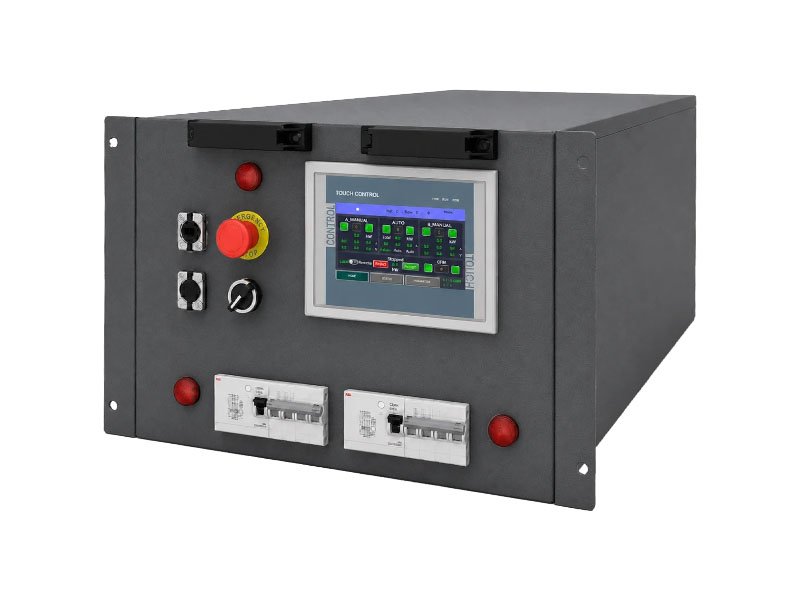
Supports local/remote control switching. Local control supports button and touchscreen operation, suitable for single load cells or small-scale, ready-to-test applications. Remote control via a host computer is suitable for multi-load cell interconnection testing scenarios and supports interconnection testing with other load cell models.
Network configuration is simple, supporting wireless networking, allowing for rapid network setup according to testing needs and multi-device interconnection testing.
With remote control software for liquid-cooled load cells, centralized monitoring and interconnection of the liquid-cooled load cells, as well as recording, processing, and analysis of test data, can be quickly achieved.
An external control power interface is provided, allowing switching between different control power supplies via a selector switch to meet various testing requirements.
Capable of performing sudden load increases and decreases in power ranges from 0 to 350kW;
The HMI displays various electrical parameters of the load test (current, voltage, frequency, power, etc.) in real time, and parameter settings can be adjusted via the touchscreen;
Test data can be exported as a CSV file for easy storage and analysis of the load status behind the data through other apps to identify potential problems;
The accuracy during load increases and decreases can reach ±3%, offering high testing precision superior to other resistive loads;
Equipped with overvoltage/current protection, inlet/outlet water temperature protection, control area temperature protection, overpressure protection, low flow protection, and leakage protection functions to ensure long-term reliability of the load operation.
Liquid Cooled Load Bank Customization Services
Rated Voltage and Standard
AC 380V/400V/415V, 50/60Hz; available in single-phase, three-phase, or three-phase five-wire configurations, compatible with both domestic and international power distribution standards.
Power Range Customization
The unit’s capacity is adjustable within the 300 kW–400 kW range; alternatively, a 350 kW split-cabinet configuration is available, facilitating easier transport and distributed on-site positioning.
Load Stepping Customization
Standard 5kW capacity, with the ability to adjust in smaller increments (1kW/2kW steps) to facilitate precise, rack-level loading and ramp testing.
Customized Cooling Media
Deionized water (standard configuration), PG25, and ethylene glycol solution—compatible with the secondary-side working fluid of the on-site CDU.
Customized Waterway Interface
Flanges, Camlock quick-connect couplings, nominal diameters (DN), and inlet/outlet orientations (e.g., bottom-in/top-out) are customized according to the on-site piping layout, with accompanying pressure-drop curve calculations provided.
Customized Control and Communication
Modbus RTU/TCP, Ethernet-based supervisory control, parallel operation capacity and coordinated control logic, as well as automated test data recording and report templates.
Customization of Protection Thresholds
Alarm and shutdown thresholds for temperature, flow rate, pressure, and water leakage shall be set in accordance with project acceptance criteria; interlock output dry contacts may also be added.
Structural and Appearance Customization
Enclosure dimensions, door lock type, caster/fixed-base configuration, ingress protection (IP) rating, and powder-coat finish (standard: Pantone 8421C metallic fine-textured; custom colors available based on client-provided color swatches).
FAQ
The 350kW liquid-cooled load bank is designed for load testing at the medium-voltage power distribution level within data centers. It utilizes an AC 400V, three-phase, five-wire (3P5W) configuration—the standard power supply format for data center UPS outputs, busway systems, and row-end cabinets. A star (Y-type) connection allows for independent loading on each of the three phases, facilitating tests for three-phase unbalance and phase-specific loading.
With a rated capacity of 350kW, a power factor of 1.0, and a purely resistive load, this unit serves as a direct substitute for actual IT equipment during load verification. It offers a load application/removal precision of ±3% and a three-phase balance accuracy of ≤3%, meeting the stringent measurement and balancing requirements for data center commissioning and acceptance.
This liquid-cooled load bank is also compatible with 380V/415V systems (with power ratings adjusted based on the specific voltage); customized design and manufacturing services are available.
A 5kW step increment allows for 70 distinct levels of fine-tuned adjustment, supporting three types of standard tests:
-
Incremental power loading (stepping up at 25%, 50%, 75%, and 100% to verify temperature rise and voltage drop in UPS systems, busbars, and circuit breakers);
-
Step-load/unload testing (abruptly applying or removing a 350kW load to evaluate the dynamic response—and resulting voltage and frequency fluctuations—of generator sets and UPS systems);
-
Power ramp tracking (increasing or decreasing power at a set rate to simulate the workload ramp-up of AI server racks). A single 350kW liquid-cooled load bank has a capacity roughly equivalent to the full-load thermal output of 2–4 high-density AI racks, making it suitable for load testing at the individual rack or row (end-of-row cabinet) level.
Converting 350 kW of electrical energy entirely into thermal energy generates a massive amount of heat. In confined indoor environments like IT server rooms—where large, open-air ventilation vents are impractical due to requirements for weatherproofing (rain/dust protection) and safety, and where space for high-capacity air conditioning units is limited—liquid cooling emerges as virtually the only viable solution. This is the core value proposition of a liquid-cooled load bank.
The required heat dissipation can be calculated using the thermodynamic equilibrium formula for fluid flow: Q ≈ 1.163 × flow rate (m³/h) × temperature difference (℃). For a 350 kW load, this translates to a flow rate of approximately 30 m³/h for a 10℃ temperature difference, or about 60 m³/h for a 5℃ temperature difference. Standard DN100 piping (108 mm per GB standards or 114.3 mm per ANSI standards) is more than capable of handling this flow rate, ensuring that the heat is removed without causing a significant rise in the server room's ambient temperature. Note: Actual flow rates and pressure drops must be calculated based on the specific capabilities of the on-site Coolant Distribution Unit (CDU) and the allowable temperature differential; piping should not be sized solely based on nominal (nameplate) flow rate specifications.
The primary risks during the operation of a liquid-cooled load bank are the interruption or leakage of the cooling medium. If the flow of the cooling medium is interrupted, the 350kW resistive elements can overheat and sustain damage within mere seconds. Furthermore, any leakage of the cooling medium—whether it be a water-based coolant (which could cause electrical short circuits) or a fluoride-based fluid (which is highly corrosive)—poses a significant safety hazard.
Our liquid-cooled load banks are designed with comprehensive safeguards, including protection against overvoltage and overcurrent, monitoring of inlet/outlet and control-zone temperatures, and strict adherence to specified sealing standards. All components are manufactured in strict accordance with design requirements, ensuring a dual-loop safety system that covers both electrical and hydraulic circuits. Specific safety features include low-flow detection to prevent dry-running, pressure monitoring to avoid over-pressurization of the piping, and leak detection to trigger an immediate shutdown of the load.
-
Local push-button control: Enables individual unit positioning, rapid switching, and load-step adjustment—the most direct method during the commissioning phase.
-
Local touchscreen control: Allows for real-time on-site monitoring of electrical parameters (such as voltage, current, power, and frequency), as well as individual unit loading and parameter configuration.
-
Remote PC-based control: Supports multi-unit coordinated control, power distribution across specific circuits, and centralized recording of test data (exportable as CSV files)—ideally suited for facility-wide acceptance testing. The remote control system is powered by an independent 230VAC/50Hz (single-phase, three-wire) external supply, which is electrically isolated from the main power circuit to ensure that control and data-logging capabilities remain functional even if the main circuit loses power. These three control modes can be switched according to the specific project phase, eliminating the need to finalize the configuration prematurely.
This liquid-cooled load bank has a maximum capacity of 350 kW per unit. Through a 1+N parallel configuration, the capacity can be scaled up to 700 kW or even into the megawatt (MW) range, allowing for the simulation of load conditions for an entire data center server room. When connected in parallel, the units can be centrally managed via a host computer (running our proprietary control software). Power is distributed among the units according to a defined ratio, ensuring synchronized ramping up and down of the load. This prevents power step distortions—which could otherwise occur if the load banks were not perfectly synchronized—during the testing of power supply equipment.\
Note: The total flow rate and pressure drop within the cooling circuit must be recalculated for parallel configurations. Specifically, the total flow rate will increase linearly, and it is essential to verify that the pipe diameter and the head (pressure) of the Coolant Distribution Unit (CDU) pump are sufficient to meet the aggregate flow requirements. Factors such as pipeline pressure loss, heat generated by the CDU pump itself, the required temperature differential (thermal margin) for heat exchange, and short-term peak surges will all increase the cooling demand. For typical liquid-cooling test scenarios in data centers (IDC), a scaling factor of 1.1 to 1.2 should be applied.
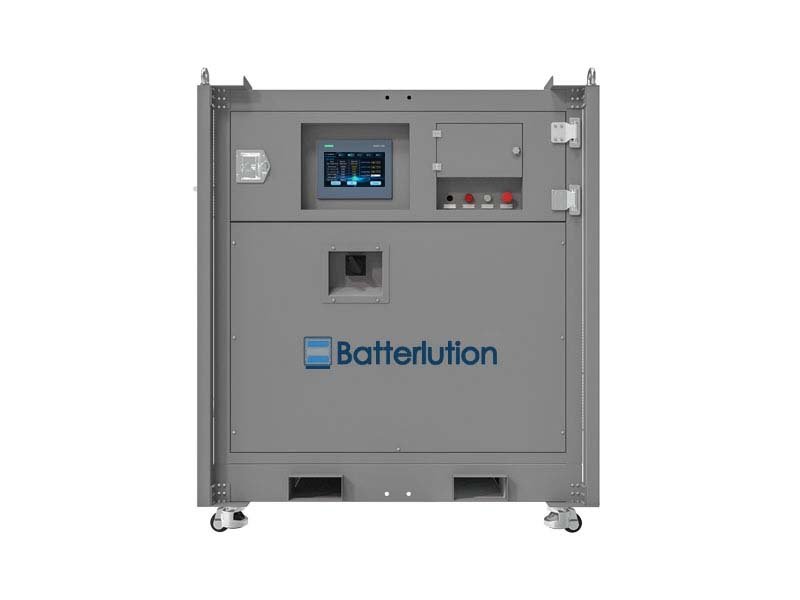
This liquid-cooled load bank measures 1450 × 1540 × 1050 mm and weighs 800 kg. It is equipped with integrated lifting points and forklift slots, facilitating easy transport and installation via crane or forklift. The unit is designed for indoor use within an ambient temperature range of -10°C to +55°C and at an altitude of ≤2000 m; it features an F-class insulation rating. Before installation, please verify the following three requirements:
-
The floor load-bearing capacity and access path width are sufficient to accommodate the 800 kg unit;
-
The power supply capacity is adequate, and an AC 400V three-phase, five-wire connection is in place;
-
The cooling water connections, drainage system, and CDU (Coolant Distribution Unit) circuit are fully installed and have passed pressure testing. For applications at altitudes exceeding 2000 m or for outdoor use, separate assessment and customization are required.
-
This liquid-cooled load bank is designed and manufactured specifically for testing data center power supply systems and liquid cooling systems. It enables the verification of several key parameters: whether the cooling capacity of the Coolant Distribution Unit (CDU) meets specifications; system stability under tiered thermal loads; the control precision of the temperature differential between supply and return water; the balance of flow distribution across multiple circuits; whether pipeline pressure drops remain within the design range; and the effectiveness of safety interlocks for low-flow, over-temperature, and leak-detection scenarios. With an adjustable capacity of 0–350 kW and 5 kW increments, it can accurately replicate thermal load profiles ranging from 25% to 100%.
-
The unit complies with CE-EMC (EN 61000-6-2 / EN 61000-6-4) and CE-LVD (EN 60204) certification standards, meeting the EMC review requirements set by project owners. Test data can be exported from the control software as CSV files, facilitating the compilation of formal acceptance reports.