Whether for next-generation, high-density AI data centers or traditional server rooms, conducting simulated full-load stress testing prior to commissioning has become an essential industry-standard procedure. Evaluating the reliability of your UPS failover mechanisms, ATS (Automatic Transfer Switch) logic, and cooling infrastructure is critical to ensuring that your facility can operate safely and stably over the long term in a live production environment. Batterlution’s specialized data center load banks apply controlled electrical and thermal loads to verify the performance of UPS systems, generators, PDUs, switchgear, CDUs, cooling loops, control interfaces, and reporting functions under actual operating conditions—effectively eliminating potential risks.
Traditional resistive load bank testing is limited to verifying whether a power supply path can handle kilowatt-level loads. In contrast, load testing for modern data centers must also encompass the validation of heat dissipation capabilities, control interlocks, alarm mechanisms, data logging, and the documentation required for project handover and acceptance. Before equipment is brought on-site, testing parameters—such as connection points, voltage levels, load steps, test duration, cooling interfaces, shutdown criteria, and reporting requirements—must be clearly defined.
In modern high-density data centers, vulnerabilities often do not stem from a single piece of equipment, but rather from the complex interplay between power capacity, cooling response, control logic, and commissioning records. Batterlution load banks utilize a five-stage, industry-standard testing process that adheres to ASHRAE 0-2019 guidelines and aligns with Uptime Institute Tier standards, ensuring that test results accurately reflect the actual operational performance of the facility.
Commissioning levels should move from component checks to integrated facility behavior. The load bank must support staged loading, sudden load application, load rejection, redundancy transfer, and endurance runs without relying on production IT hardware.
Commissioning Level |
Typical System Boundary |
Load Bank Test Focus |
Record Required |
|---|---|---|---|
|
Level 1-2 |
UPS, generator, switchgear, PDU, busway, CDU components |
Nameplate check, wiring check, local control, protection setting |
Inspection record, connection point, protection setting |
|
Level 3 |
Single power or cooling subsystem |
Step load, full-load hold, load rejection, alarm verification |
Voltage, current, kW, frequency, alarm event, operator notes |
|
Level 4 |
Integrated UPS, generator, PDU, switchgear, CDU and BMS/SCADA |
Source transfer, A/B redundancy, emergency unload, control signal mapping |
Timestamped event log, Modbus/SCADA points, pass/fail exceptions |
|
Level 5 |
Operational simulation before live IT handover |
Endurance run, IT load simulation, heat load stability, reporting output |
CSV raw data, PDF summary, trend curves, commissioning sign-off data |
Tape screen and drag left or right to view the extra table parts.
Liquid cooling commissioning needs controlled heat load, not only electrical kW. A CDU may pass a no-load inspection, then show flow imbalance, pressure drop, valve delay, or alarm logic gaps once heat is introduced into the loop.
For CDU testing, define rack heat target, coolant type, inlet/outlet direction, flow range, pressure limit, Delta T target, leak alarm behavior, and shutdown threshold. Export the test record before connecting GPU racks or other high-value IT equipment.
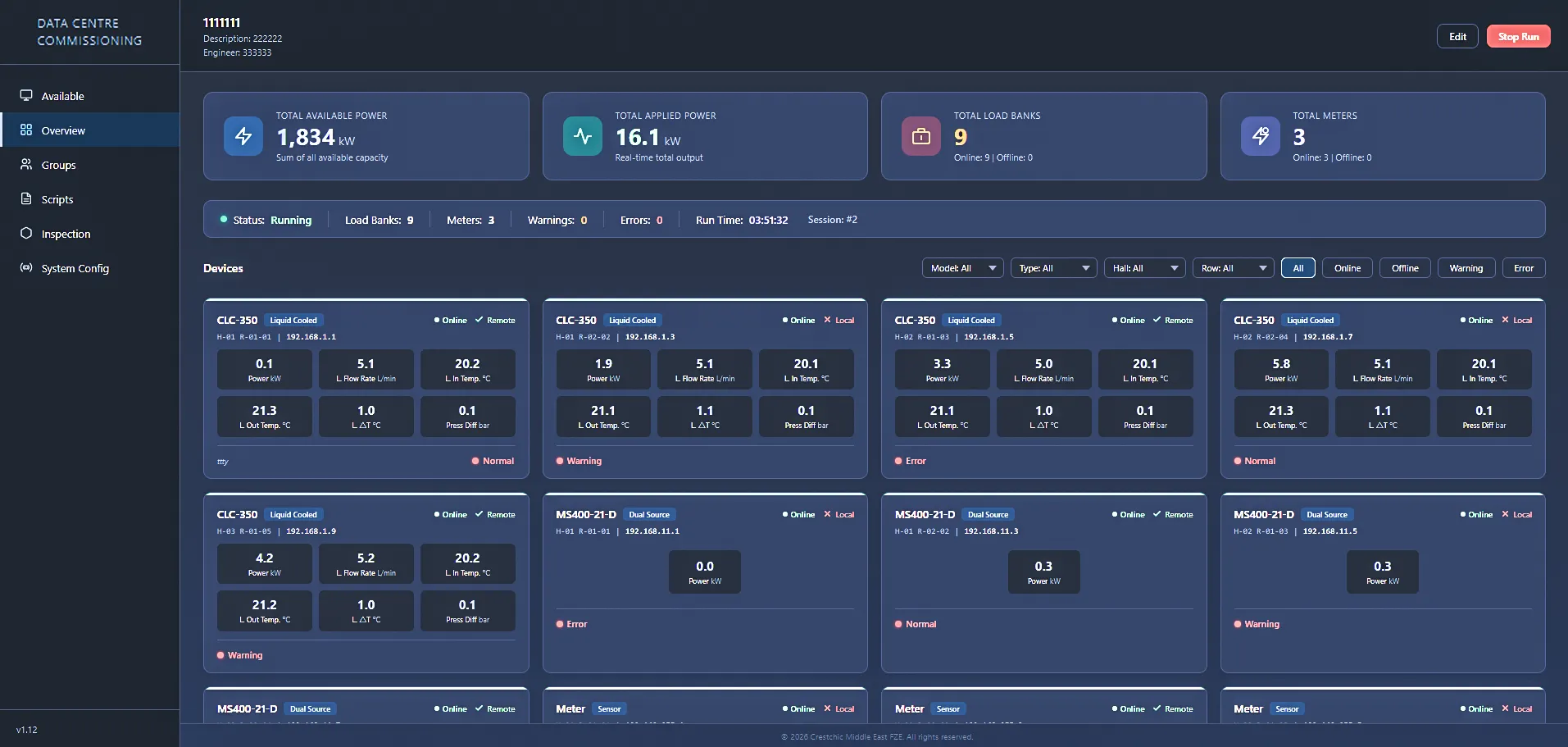
A useful commissioning report is not a screenshot. It should state the test boundary, load sequence, step duration, acceptance criteria, measured response, exceptions, and final handover notes. For repeatable projects, automated CSV and PDF export reduces argument after the site test.
Test asset ID, connection point, voltage, load bank configuration
Load step, holding time, kW, kVA, current, frequency, power factor
Coolant flow, inlet/outlet temperature, pressure, Delta T, leak alarm
Source transfer event, emergency unload, protection trip, operator action
CSV raw data, PDF summary, trend chart, exception list, sign-off notes
At minimum, test UPS output, generator acceptance, PDU or busway loading, switchgear transfer, cooling response, control signals, alarms, emergency unload, and report export under staged load.
Use a liquid-cooled load bank when the commissioning scope includes CDU capacity, coolant flow balance, Delta T validation, leak alarm response, or high-density IT thermal load simulation.
The final report should include load step, duration, voltage, current, kW, kVA, frequency, coolant flow, pressure, inlet/outlet temperature, alarms, CSV raw data, PDF summary, exceptions, and sign-off notes.
Select by test boundary. Rack-mounted systems fit rack-level and CDU-loop validation. Containerized or custom systems fit high-capacity generator, UPS, switchgear, and outdoor connection tests.
Ready to find the perfect load testing solution? Contact our team today.

